
-
-
Recent Posts
Top Posts & Pages
Categories
Archives
- October 2025
- July 2025
- December 2024
- October 2024
- April 2024
- March 2024
- August 2023
- December 2022
- October 2022
- September 2022
- May 2021
- October 2020
- May 2020
- March 2020
- October 2019
- September 2019
- June 2019
- May 2019
- April 2019
- February 2019
- January 2019
- December 2018
- November 2018
- October 2018
- September 2018
- August 2018
- June 2018
- August 2017
- May 2017
- May 2016
- February 2016
- December 2015
- October 2015
- June 2015
- May 2015
- April 2015
- March 2015
- November 2014
- September 2014
- August 2014
- June 2014
- May 2014
- April 2014
- March 2014
- January 2014
- December 2013
- November 2013
- October 2013
- September 2013
- August 2013
- June 2013
- May 2013
- April 2013
- March 2013
- February 2013
- January 2013
- December 2012
- November 2012
- October 2012
- August 2012
- July 2012
- May 2012
- April 2012
- March 2012
- February 2012
- January 2012
- December 2011
- November 2011
Blogroll
Blog Stats
- 53,683 hits
Meta
differentiation
A great friend and colleague of mine reached out to me this weekend as he was reading a book for his school’s leadership members (of which he is one) on differentiation. His question: “All I can think about is how these ideas which are so clear in other areas is hard to do in a group literacy instruction/assessment in choir.” He asked me if I’ve ever written a blog post on the subject, and the answer is no. For the reasons he’s getting after. My quick response articulated what I think the fundamental challenges are, but I thought it might be a good exercise for me to try and expand on that here. For the purpose of providing a focal point, I’ll address the challenge as it pertains to High School choral. You can derive from this key points I suspect as they pertain to other grade levels, as well as to instrumental ensembles.
Let’s begin with my premise that learning targets (learning indicators) must be measurable. National Standard indicators for Ensembles such as, “Compose and improvise melodic and rhythmic ideas or motives that reflect characteristic(s) of music or text(s) studied in rehearsal…” is not measurable. It is an activity. “Select varied repertoire to study based on interest, music reading skills (where appropriate), an understanding of the structure of the music, context, and the technical skill of the individual or ensemble.” That’s a check box. And a check-box activity is, by it’s very definition, binary. Either ‘ya did or ‘ya didn’t. Binary activities are not measurable on any educational spectrum. Can they be useful? Of course. But educationally valid as a learning target? No. So I’m not talking about those. Learning Targets must also be objective. Subjective indicators (“Identify reasons for selecting music based on characteristics found in the music, connection to interest, and purpose or context” or “Demonstrate how interests, knowledge, and skills relate to personal choices and intent when creating, performing, and responding to music“) disqualify themselves because any “target” that relies on personal opinion or bias really loses any educational weight. So we’re not going there. Finally, measurable indicators are not vague. One of the National Standards for Connect says, “Share personally-developed melodic and rhythmic ideas or motives – individually or as an ensemble – that demonstrate understanding of characteristics of music or texts studied in rehearsal.” This is the “novice” level indicator by the way. I’m not referring to those.
Let’s get down to it. In an ensemble rehearsal, using the York High School performance indicators as my reference, I have 13 indicators listed under the standard, B. Performance Literacy – Application. These are:
- Perform: pitch
- Perform: rhythm
- Perform: re-create; application of solfege/numbers)
- Perform: posture
- Perform: technique; use of mouth/jaw
- Perform: tone
- Perform: articulation
- Perform: eyes
- Perform: tempo; steady beat
- Perform: intonation (honors ensembles)
- Perform: breath phrasing (honors ensembles)
- Perform: shape phrasing (honors ensembles)
- Perform: visual presentation (honors ensemble)
Let’s compare this with Common Core for High School Algebra:
- Interpret the structure of expressions
- Write expressions in equivalent forms to solve
problems - Perform arithmetic operations on polynomials
- Understand the relationship between zeros and
factors of polynomials - Use polynomial identities to solve problems
- Rewrite rational expressions
- Create equations that describe numbers or
relationships - Understand solving equations as a process of
reasoning and explain the reasoning - Solve equations and inequalities in one variable
- Solve systems of equations
- Represent and solve equations and inequalities
graphically
Take a quick look at the first set of High School Life Science indicators:
- Construct an explanation based on evidence for how the structure of DNA determines the structure of proteins which carry out the essential functions of life through systems of specialized cells.
- Clarification Statement and Assessment Boundary
- Develop and use a model to illustrate the hierarchical organization of interacting systems that provide specific functions within multicellular organisms.
- Clarification Statement and Assessment Boundary
- Plan and conduct an investigation to provide evidence that feedback mechanisms maintain homeostasis.
I could add other subject areas as well, but this will do. Take a look at the learning targets for music and those for subject areas such as math and science. Here are two things I notice as very significant differences (you might find more, but I’ll stick with these for our purposes here):
- Most notably, the indicators listed for math and science are sequential. The indicators for music are not sequential. You cannot perform as a singer in a choral ensemble without – simultaneously – exhibiting indicators 1 through 9. You can’t say to your class, “Okay, we’re going to focus on tone so please don’t sing on a pitch, or even breathe. Just tone please…” You can’t say, “…we’re going to focus today only on pitch, so please don’t use tone, open your mouth, breathe, watch my conducting, sing any rhythms at all, etc.” Can we “focus” on just one or two indicators at any given moment? Not only is the answer a resounding yes, I would submit that pedagogically we must. But unlike other subject areas, we can’t store away the other learning targets at the same time. In a sequential curriculum, concepts are built on one another. So a mastered indicator or two in math then leads to the next, and the prior ones are built upon. In music, we aren’t sequential. Every indicator is developed simultaneously… independently I would hope, but simultaneously. I’ll go one step further. Vivaldi’s Gloria, measure 6 of movement 10, “Quoniam tu solus sanctus”. A half rest followed by a dotted 8th followed by a 16th and then two 8th notes on, “Quo-ni-am tu”. Assume a metronome marking of 120. That means that the 16th note is an eighth of a second long. The first syllable in measure 10 has three components to it: “k”, “w”, “Oh”. Each one of these then is less than 1/16 of a second long. BUT, they are not equal. The emphasis is placed on the vowel so the consonants are even shorter. BUT, those consonants have to have an explosiveness to them to be on equal dynamic footing as the vowel. AND they have to be the same vowel across the board, formed with the same shape of the mouth, both inside and out. AND that vowel shape is not allowed to be impacted by the consonants beforehand. And this must be done at the same dynamic level as everybody else. UNLESS the numbers of each section of the choir are not perfectly balanced, in which case SOME have to be quieter and some louder. THEN the tempo must be perfectly aligned. AND the articulation precisely the same – legato? Marcato? Staccato? And this must be done on their respective correct pitches. And that’s for one half of one measure in a work in which the choir sings over 300 measures. In latin. WHILE ASSESSING THE INDICATOR OF JUST PITCH!
- The indicators for math and science seem to be contextual. That’s a good thing, for many reasons. My list for the YHS music standards is not. There’s a really good reason for this too. If they WERE contextual, this is what it would look like. Instead of “B1. Perform: pitch”, it would be:
- pitch, in unison – head voice
- pitch, in context of traditional harmonies- head voice
- pitch, in context of close harmonies- head voice
- pitch, within intervals of a 3rd or less- head voice
- pitch, within intervals of a 5th or less- head voice
- pitch, within the interval of an octave- head voice
- pitch, from an interval greater than an octave- head voice
- through 14. all the above in context of chest voice.
Dude!!!! Yeah, fourteen different and essential learning targets for ONE INDICATOR, PITCH!
When I student taught, I’ll never forget my cooperating teacher ripping me apart after an amazing run-through of a song I had taught the honors choir. I thought it had gone brilliantly, and she just looked at me and said, “Rob, do you think the tenors are just going to fix that B flat at measure 71 on their own?” There was a specific reason the tenors sang the entire rest of the song perfectly, but not on that one note in measure 71. Was it the interval? The harmonic context with the rest of the group? The tessitura? Incorrect interpretation of the pitch in the music (the accidental)?
So, to me, those are the two most significant differences between learning targets in the ensemble class and those in virtually any other subject area. It could be argued that World Languages battles the same thing as a performance class (we have far more in common with French 1 and French 2 than we could ever dream of having in common with Visual Art, but that’s another blog post for another time). But ours remains unique in that we are in the skill development of Re-creation (as opposed to “creation”, examples being composing or scat-singing) and that has serious ramifications to instruction, learning and assessment.
But back to the point of this blog post, I would submit it also has incredible ramifications to differentiation in the choral classroom. Look, singing on pitch with characteristic tone while accurately performing the correct rhythms with posture that supports the breath and an open and relaxed mouth/jaw while following the visual cues of the conductor, and doing so while others around you are singing DIFFERENT pitches, and doing this EVERY SECOND you are singing, man, there is no wiggle room. So how do we get our students there? Well, we vary the literature. We vary the tempo. We vary the focal point (tone vs. pitch vs. posture/technique…). We vary the tessitura. We apply concepts across many different applications, both in warmups and rehearsing the music. We vary the actual music (context). In other words, we are models of differentiation, because that is all we ever do. You can’t “apply” differentiation to the choral classroom any more than you can apply water to a pond. It’s just… there. Look at this list of SRF strategies as I would apply them in my chorus class:
1. Structure
- Varying Scaffolding: Offer different levels of support, one on one with some students while others work more independently.
- Breaking Down Tasks: Breaking down the learning targets into chewable pieces, such as independently assessing rhythm vs. tone. Done!
- Providing Choice: Offer students a choice of how they demonstrate their learning (“For your pitch assessment, you may choose measures 1 through 10 of the song of your choice and submit it in your video assessment.”)
- Flexible Grouping: I can have students submit assessments on their own or if they wish with a peer singing a different voice part.
2. Resources
- Diverse Materials: Provide a variety of resources tailored to different learning styles and levels, including Sight Reading Factory, sheet music and practice tracks.
- Technology Tools: Utilize technology to support learning, such as those mentioned above as well as links to youtube videos to help gain context and use as an aid to practice with.
- Supplemental Materials: Offer additional readings or videos that address specific skills such as posture, singing without tension, accessing head voice and so on.
- Access to Support: Ensure students know how to access additional help from the teacher, peers, or online resources.
3. Focus
- Adjusting Learning Objectives: Tailor the specific learning objectives for different students based on their current understanding, and making arrangements to have them meet targets through a more focused approach, such as a bass matching pitch down the octave (which then can be moved up over time).
- Prioritizing Key Concepts: Focus on essential skills and concepts for some students, while others explore more advanced topics such as intonation and phrasing.
- Varying Depth of Inquiry: Allow students to submit supplementary assessments that allow them to demonstrate advanced skills or class skills in a different way, such as songs they enjoy singing to in the car or at home.
- Personalized Feedback: Provide specific and actionable feedback that addresses individual student needs and next steps ALL THE TIME through Mote in Google Classroom. ON EVERY ASSESSMENT.
Any of this look like it goes outside the realm of basic, fundamental necessities in teaching our content? So, let’s wrap this up. Due to my indicators not being contextual, I get to vary the context every single day, dozens if not hundreds of times each class. And so do you. And because our learning targets are not linear or scaffolded, we have students at every end of the spectrum on every single indicator at all times in our class. The only way we can teach our content is through differentiation. Let me clarify: the only way we can teach our content in any educationally valid way is through differentiation. That may come across to non-music people as a bit pompous or presumptive. But I came across the following definition of differentiated instruction online and I really like it:
Differentiated instruction strategies adapt teaching to address students’ unique learning abilities, styles, and readiness levels. Instead of using a one-size-fits-all approach, teaching and learning practices are modified to match the needs of the students in today’s diverse classroom. This approach to differentiated learning transforms how teachers deliver content, engage students, and assess understanding.
I think this translates beautifully to what we do in music education, the choral classroom specifically.
george seurat part two
Eleven years ago I posted george seurat and choral performance, describing pointillism as a metaphor for how we as choirs/performing arts interact with our audiences. On Monday we had our first of two choral concerts and things went well. Very well. But we do have our second one coming up this Monday too. The reason I do two concerts is the concert revision process I have woven into the program. As a part of that this week, I talked with my Chorus and reiterated to my Treble Choir the relationship between Seurat and our work as a choir. I described the “blue” and “red” that we strive for; what we are working on in class, and the subsequent purple that can then evolve if we do it right. To that end I showed them the following pictures, in this order:
George Seurat’s “dots”; one of his paintings:

Backing up, same painting:

Backing up some more:

And now the painting that you observe in the museum:

The first thing you notice by the time you back all the way up is that, while you do still notice the dots per se, you really aren’t looking at them, you’re looking at the picture they create. And that really is the alchemy, isn’t it?
I was talking with my students about this in class on Wednesday, and one of my kids said, “This is about life too.”
Wow.
And I woke up this morning thinking about that after our Chamber Singers Rotary Club runout yesterday morning. It was a real high, both for the kids and for myself, though for different reasons. For the kids, it was about putting out there all the work they had been doing, culminating in a performance for the most appreciative audience you’d ever want to see. There were real tears coming from the audience side, community members who were taking in what these wonderful teenagers had to offer them – it really was an amazing 20 minutes. For me? It was just watching it all occur. Kids who have worked their tails off on the blue and red dots for 3+ months… blue and red dots of phrasing, tone, intonation, articulation, pitch, balance… blue and red dots of breath support, raised soft palates, singing through their top teeth, high torsos, relaxed necks and jaws… blue and red dots of smiles, eyebrows, body inflections… blue and red dots of turning accompanied literature into a bona fide a cappella program literally the day before… blue and red dots of kids who have gone through personal trauma and are still here… blue and red dots of kids who were sitting on the floor of Village Elementary School as 1st graders watching the Chamber Singers walk by them on Caroling Day, December 2014 who were now singing in the ensemble… blue and red dots of kids – children – who have morphed and evolved into the wonderful young adults that they now are. Watching all of them sing to members of the community who helped build the program over the last 25 years… blue and red dots of supporting the school budget… blue and red dots of donating funds that helped students to perform in New York City… blue and red dots supporting bond initiatives that built a music wing and a new Auditorium… blue and red dots of word of mouth around town about the YHS music program.
Yesterday during that concert it stopped being about just the music. It really is about life too.
Any good educator in any discipline works in the weeds, in the belly of the details. And how precious it is when we get to poke our heads out from under it to see evidence of the larger picture that has been evolving all along. This week has been a joyful reminder for me that the same metaphor is all around me in so many other ways too. My hope for all my friends and colleagues this season is to take those moments in when you can, to just step back for a moment to look at the picture that been created around you. It is pretty powerful stuff. And it’s all around every one of us.
Make sure you set aside some time to look at it.
group voice lessons?
Scoring my chamber singers and S1 chorus video assessments this morning and felt compelled to write a brief blog this morning. My “why” to my choral program is to develop individual musicians. The foundational piece is the development of the individual student’s technique as a singer. The music they sing in class is a vehicle through which they can apply and refine their technique but no music can “teach” technique. This is why adopting a mindset of group voice lessons is essential: without it, it’s just, “singin’ together”. Which is not an academic objective for individual students. Some strategies for my YHS Indicators:
TONE; LOFT – I preach “ring” (the resonance) and “loft” (the space). I refer to the latter as an inverted lightbulb space. Since most speaking voices tend to have more ring than loft, my starting point is to develop the loft. When you’re doing group lessons, it really is about throwing the spaghetti at the refrigerator, because one descriptor is going to work for some but not for others. Some of my students immediately broke through when we take class time to explore with the tip of our tongue the space where the teeth and gums meet, then further back to the hard palate, and then further back to the soft palate (eureka!!) – and finally what it feels like to raise that in a yawn sensation. For others it’s the “marshmallow” feeling inside the mouth. For others it’s “novocaine jaw”. Come up with a variety of ways to explore the loft as a class and see what happens. It’s then essential to practice singing without it (remember that sensation and sound) the practice with ONLY loft (it will sound odd and feel weird) and then try singing with a speaking voice but WITH loft attached (should sound more mature, full, open, free, etc… ask the kids what they hear). Once established, it has to be the non-negotiable *every* time they sing. If you’re doing a warmup that works against good loft, be careful with it: do you really want to go there and undo their good work to that point?
TONE; RING – There are so many approaches to developing resonance out there, I hardly need to even mention this. But I will say the most successful pieces of spaghetti I’ve tossed is the “singing through the top front teeth”. I’ve already talked with my students about the resonators, nasal cavity, etc, so they know it isn’t the front teeth that cause resonance. However, that has been an effective way for many of my students to find it. For others it’s identifying the tone of their speaking voice. For some it’s singing from between the eyes. Some of these don’t work for me personally, but that’s no reason not to use them. If an approach works for even one of my students, it’s essential to explore that approach as a group. One more thing: earlier in my career I preached a 50/50 split of ring and loft to convey that the singing voice must have both. A breakthrough for one of my kids a number of years ago was when we thought of it as 100/100 split. Then they disconnected from each other and were reinforced as independent entities. I swear by that mental approach now.
BREATH – I have multiple approaches to breathing (depending on whether I’m teaching a CP class or an honors class is a big variable… the first is learning it and taking baby steps over the course of the semester, the latter is all about application in warmups every day). My basic approach is to teach the coffee can: singing with a coffee can on your belly and the can moves outward when you breathe. We do this in class with fists, slow breaths, quick “surprised” breaths, technical lying down on the floor with something on your belly breaths (literally!!! I never require a class to do this, but I invite anyone who would like to and the others observe… it’s never failed in its effectiveness for those doing the lying down *or* those observing). We do a 3 second inhale using a shoulder breath and then see how long you can go “shhh” before having to sit down because you ran out of breath (I count out loud the seconds while they are doing it) and then standing up, doing the same with an open mouth and fist on the belly breath and discussing how much longer they were able to go “shhh” for the second time and why. Then that also becomes a non-negotiable in class from then on. Do I know for sure they’re all doing a good diaphragm breath? Absolutely not. But I can be a jerk about reinforcing it, and continually calling it out. Most if not all the kids, due to already discovering first hand how much better they breathe when they do so, have bought in to the benefit. By making this a foundational expectation, it’s no surprise that the students do begin to identify the fact that, “your singing breath is not the same as your speaking breath”. A belt of noses, singing from the belt buckle are a couple of other isolated things we will do in class. I also insist on an open mouth for their breathing, and THAT I do know for sure if they are all doing. As a matter of fact, I will randomly give an assessment on “jaw” without telling them in class from time to time (it can be a low, open jaw while they are actually singing AND/OR while they are breathing… over the span of a class by scanning, it is quite easy to give an accurate score for each individual student). For honors classes, I will require them to do the laying on the ground with something on their belly from time to time. I also am constantly calling them out on their application of their good breath: extending phrases, getting louder without noticing any other physical difference, and removing anything that inhibits good breathing technique… such as tension.
TENSION; SHOULDERS – We talk in class a lot about how there are literally no muscles that connect the shoulders to the breathing mechanism, and that we have to manually MAKE the shoulders move to get them to go up during breathing. The proof? The laying down exercise that established the breath: not a single person falls asleep moving their shoulders 😉 Technicians of vocal pedagogy would have a lot to say on this but, dude, I’m working with 15 year olds who aren’t going into a singing or music career. Whatever get’s them to apply the concepts, game on. In any group setting it is a piece of cake to hold your singers accountable for shoulder movement. When I see it, I don’t call out individuals (that’s a no-no in any group setting or voice lesson). But I do stop the whole group and call attention to it. Invariably the culprits make the adjustment due to stopping and calling it out. This also begs by the way that torsos be high enough to begin with (posture) so that the shoulders don’t have to go up due to poor body position.
TENSION; NECK – This is another easy one to see, a tough one to fix. But I address fixing this to a) the breathing mechanism, b) the “ring” placement and c) the novocaine jaw. Neck tension may be the #1 inhibitor of good singing technique that I’ve experienced in my singers over the years, particularly tenors and sopranos, and addressing it – continually – in a group setting has to be a priority for any choral program wishing to develop good vocal technique. The other thing I will will do is talk about the correlation between head direction and height of pitch. When singing higher notes, the air passage in the neck has be very open and we discuss how raising the head actually constricts. In a perfect world, the head never moves to accommodate pitch. But I preach that, if you are going to move it, move the head the *opposite* direction of the note. In actuality I don’t care about someone moving the head up as they sing lower notes: they tend to never do that. But if they are moving their head down ever so slightly as they sing progressively higher notes, it’s amazing how much neck tension gets removed. The moment I see neck tension in rehearsal – warmups or especially in the literature – I stop what we’re doing and address it.
TENSION: JAW – This discussion can tie in with the concept of loft, and I often do tie them in together. We do flutters (“pppppp” with the lips on pitch, followed by “aw” of the same pitch or pitches to see if that frees up the jaw), and I also try to identify early on if there are any students with legit medical issues around their jaw. I make VERY sure to tell the students not to over extend their jaw when it goes down low, but to keep the jaw free whole also open and a lot of imagery around that.
A few follow-up points…
- I invariably have the students help me come up with imagery tips that work for them when something finally clicks. The entire ensemble benefits from hearing multiple ways of approaching or solving a pedagogy issue.
- Every, and I mean EVERY single student gets feedback from me on their own voice every 2 to 3 weeks, invariably through video assessments which usually require a video component. I will assess them on tone and/or jaw (2 separate indicators) but connect these two in my personal feedback (my video assessments in detail here). When they get my voice recording giving them feedback, I will always mention their tone and their jaw placement. If I see tension ANYWHERE, it’s addressed with possible approaches how to work on it in class the following two weeks.
- All of this takes time away from our literature, but 100% of it makes our literature performances supremely more musical. If our literature is there to apply individual vocal technique, the students will be the beneficiaries, but so will the literature. If I want my concerts to sound better? Focus less on the songs, more on the students.
- All this requires patience on the part of me the teacher as well as my students. Sometimes the changes are incredibly gradual. That doesn’t mean they’re not happening. If you establish that your choral classroom is a group lesson, the students will buy into this. Trust me.
- One of my classes is something called Vocal Workshop which meets during the students lunches, but is for academic credit. This IS the opportunity to do 1 on 1 instruction, usually with other students present and contributing to the lesson/providing feedback and tips themselves. While this is not a group lesson per se, I draw the parallel to a science lab which extends, enhances and compliments their learning in class. I can’t recommend it enough.
I have often reminded my students of all levels that the voice is the only instrument ever created that they will never ever be able to see nor touch. Consequently, while everyone can sing, it is extraordinarily difficult to sing “well”, and usually has nothing to do with talent. Developing the building blocks to good vocal pedagogy is perhaps *the* most important gift we can give to our ensembles.

nhmea workshop 4/5/24
This is one of my favorite workshops to present and I hope you are able to take even one or two things away from it today!
Here is a link to today’s Slideshow: https://drive.google.com/file/d/1nYxNA-7dRz_0sK1FDp-fT-c8XeldrORY/view?usp=sharing
Here is a link to the YHS music standards and indicators, the relevant standard to today’s workshop being the “B” indicators: https://docs.google.com/spreadsheets/d/1e2IR9fpeVenfW1OOD_D6nNlHaNrjgbO_HRvrs8Z0ilw/edit?usp=sharing
Posted in Etcetera
Leave a comment
grace
This semester has been one of success stories so far. I posted on social media last month about my general chorus and the trajectory they’re now on, and the first week of March I posted about my Chamber Singers and their choosing to up their game. My singers in Vocal Workshop this term are also crushing it, we are having many breakthrough moments together. The one class I haven’t talked about is my Treble Choir. For context, this year it is an honors class made up of 7 Freshman, 13 Sophomores and 6 Juniors. They are all in there by teacher selection (or 8th grade recommendation by Jen Etter). We are almost 7 months in and I still haven’t found the key to unlock what I feel is their potential. The problem? It is the first class I think I have ever run with not one single Type A personality in it. One of the skills I think I bring to the table as a teacher is bringing disparate personalities and skill levels together to create a whole. I love doing so and after all these years I have quite the toolbox at my disposal to help me do so. But I’ve never had a class where everyone is in many ways a reflection of each other. And we meet block 1 at 7:50 each morning. There are days I literally cannot get them to talk. I try being a goofball (doesn’t take much…) just to get them animated, but our block 1 together every other day is a pretty quiet venture and just getting them to sing out is pulling teeth sometimes. You get the picture.
I am really proud of their individual and collective progress this year; they sound nothing like they did in the Fall and their skill set has grown. But two weeks ago we hit bottom. The girls were fine in rehearsal, but I got a sense they were just kinda, “there”. Nothing I was doing was motivating them, nothing setting them on fire. The same week they had a bi-weekly home video assessment due. The deadline was Thursday night which gave them four days to get it done, but I always give a built in extension to the following night in case they need it. As a bonus, Friday was a day off for them due to PD at school. I woke up Saturday morning excited to see how they did.
Half the assessments were missing. Half.
I was mad, angry. I was confused. I think most of all I was offended. Here I was doing everything I could to facilitate their growth: they have a state of the art rehearsal space, resources galore (they have practice tracks for all their music), gobs of time given to do their work outside of school, and 13 of the kids couldn’t lift a finger enough to submit their 60 seconds of video. That also presumably meant they hadn’t been finding the time to practice their work outside of class either. Honestly, I was really upset.
But then as the morning went on, I thought about a Stephen Smith story I told to my Chamber Singers just two days earlier. I told it for an entirely different reason, but the story was a lesson Steve taught me and my classmates my Sophomore year at Keene State College as an Ed major. It was to always look beyond what you see, because there’s always more there, you just need to be open to it.
So I went into school this past Monday ready to see Treble Choir block 1. They were tired beyond words as daylight savings reared its ugly head and polling the girls, on average they got about 4 to 5 hours of sleep and their bodies were saying it was 7am. I shifted gears and played an impromptu game of Jeopardy with them for the first half hour. I called my accompanist and told her not to come in. The students and I just had fun together and laughed a lot as we woke up. Then we had a solid rehearsal for 25 minutes. Finally, with 10 minutes left in class, I sat them down and I said, “I have a story for you.” And I began:
Steve was into Gestalt and new age theories, and he told us about when he began his career in the early 1970’s, he paid $500 and signed up for a weekend retreat somewhere led by an authority/author on Gestalt principles. I don’t remember the guy’s name, I’ll call him ‘Dr. Tim’. Dr. Tim held the retreat somewhere out in the woods in New Hampshire and all food and lodging was covered in a rustic setting. Steve and about 15 others got there mid afternoon on a Friday and met in a large room. Dr. Tim introduced himself and said, “We’ve got all your needs met this weekend, your bunks are upstairs and our chef is making supper as we speak (the chef came out and said a quick hello) and all you need to do is keep an open mind.”
“The first thing I want you to do is go out in the woods for 45 minutes and find an item that speaks to you; something you feel you can identify with.” The attendees kinda looked at eachother but went and did as they were told. 45 minutes later, they came back with things like acorns, twigs, a bird feather, etc. Dr. Tim had them sit in a big circle on the floor and said with a chuckle, “Okay, now please place your item in front of you. I want you to contemplate your item for 20 minutes.” Now everyone was looking at eachother like, is this guy serious? But they did as they were told and stared at their item for 20 minutes. Then when time was up, Dr. Tim was suppressing his laughter and he said, “Now, please take the item to your immediate left, and take it, place it in front of you, and contemplate it for 15 minutes.” This prompt started to get a rise from some of the participants but they again all did as they were told.
At the end of that 15 minutes it was supper time. Dr. Tim said, “I need each of you to pair up with someone for Supper and try to really get to know them, and it has to be someone you’ve never met.” Well, Steve being the kind of person he was, thought to himself, who was the least likely person to have someone ask to eat with them? And he decided that the person he wanted to eat with was the chef! A truly Steve move. So he went in and asked the chef if he could eat with him. The chef understandably gave him a bit of a weird look, but said okay, just as soon as he was done serving everyone. Steve told us that the two of them sat down and over the next half hour or so, hit it off big time. It turns out they had a ton in common, and shared many of the same beliefs and struck up an immediate friendship. Go Steve, that’s the kind of guy he was. They decided to catch up again over the weekend if they had a chance.
So it’s now after supper, and Dr. Tim is just truly enjoying tormenting everyone. His next prompt was, “Go out into the woods and see if you can find another item that speaks to you.” At this prompt, one of the attendees got mad. They said they didn’t pay $500 to go find twigs, they wanted to know when the instruction was to begin. And Dr. Tim just laughed. That riled up another who said this was beginning to look bogus. Dr. Tim was laughing harder now. Another said, “If this is what the weekend is going to be, I’d like my money back!” Dr. Tim smiled, “I haven’t cashed a single check yet, I have them right here – if you’d like to go, come on up and get your check!” It cleared the place out! Steve told us that everyone was bewildered at least, ticked off at most, and every single person went up to get their check so they could leave. Dr. Tim wasn’t even sad, he was smiling the whole time he was saying goodbye to everyone!
Steve was last to walk up to Dr. Tim. He looked at him and said, “I don’t want my check back. I’m going to leave too, but somehow I have to believe something happened today I can learn from. And you know what? There were no guarantees either way, so I’m going to chalk this one up to experience. Please keep the check.” Dr. Tim for the first time became serious, looked right at Steve and quietly thanked him. Then he went into the kitchen to say goodbye to the chef. Tim told him that if nothing else he made a new friend! The chef told him the same, “Here’s my phone # and address. It was great meeting you too – if you are ever in the area, look me up. We have much more to talk about, let’s do so!” And as Steve turned around to leave, the chef added, “And by the way, if you can, tune into Good Morning America on Monday morning, they’re having me on as a guest!” And Steve was stoked, he had met a celebrity chef!
As Steve drove home, he was thinking about the day. And all of the sudden, he told us in class, it dawned on him. He realized what might have happened. Turns out he was right. Monday morning he tunes into Good Morning America. At some point, they say, “Now for our next guest we are excited to welcome a well known author on Gestalt Theory and he’s here today to tell us more about it.”
And out walks the chef.
The reason Dr. Tim and the actual chef switched places to begin the retreat was to find out who was truly willing and able to go through a weekend where they would have to look beyond what they think they see, to go beyond their own filters of pre-determined expectations and go beyond their own perceived boundaries. Steve looked at us Sophomores in his class and asked us, “Do you think that was worth $500? I’ve never looked at people the same way ever since. Neither. should. you.” That story changed my life and I remember Steve telling it to us in class like it was yesterday.
I then looked at the girls in front of me and said, “The reason I just told you that story this morning is because half of you didn’t bother to submit your assessments to me by Friday night. I was hurt, I was angry, I was mad and frustrated. I not only gave you four days to submit it, I gave you a 5th day as a build in extension and you even had the day off – and still chose not to do it.” As I was saying all this I could see some of the class start looking down at the floor and one of the girls actually started to tear up. ” I told you the story because I remembered what Steve taught me, and that’s to never look at anyone with judgement. I don’t know what the 13 of you were going through, I don’t know your circumstances, I don’t know what’s going on in your life. There’s a lot about you I see but most of who you are I don’t see. So I promise you: I will never judge you. I’m not you, I’ll never pretend to be. I will always hold you accountable but I will never judge you. So I’m not mad. I’m not upset, I’m not hurt, I’m not angry. I’m not even sure I’m disappointed now. That’s why I just told you this story, so you’d know why”
And with that the bell rang and they were off. Fast forward two days later Wednesday morning: best rehearsal we’ve had in seven months.
Showing grace. That wasn’t Steve’s objective in telling impressionable college sophomores his Dr. Tim Story, but it is a direct illustration of how to justify it when it seems like there’s no other justification available. I begin each morning with a cup of coffee and a quiet Bible study. This week ironically, even this morning, I’ve been reading in the New Testament a ton of God’s grace on display toward his often rebelling children of Israel. There are always consequences to actions, choices and behaviors. But in addition to that, and well beyond that, grace is a simultaneous expression of unconditional love that this world and our students in particular so desperately need. There was a time in my career where I believed accountability meant “justice” in every harsh iteration of the word. After all, how else will our students learn and grow from their mistakes?!? But as I’ve continued my career, I have slowly learned that the time to love on someone is not when they are making your life easy and they do everything you want. The opposite is true. You love on them when they are being difficult, inconvenient and complex human beings. Because you don’t know what’s really going on behind the scenes. Because you never know when you’re judging Dr. Tim but you’re really actually interacting with the chef. Only after fostering every kid, not just the convenient ones at the convenient times, do you unlock in them what they’re all capable of being. Or at least have half a chance to be.
This was heavier blog post this morning, but it’s one on a topic I really needed to be reminded of this month. I wrote it today in case I’m not the only one.

Posted in Etcetera
Leave a comment
analytical assessment
Last month I was honored to be a guest on Kyle Smith’s The Growing Band Director Podcast – a highlight of my Summer. After our time together he decided to call the episode, “Teaching Analytically“. I’m really proud of that, because it connects to the fundamental goal of my choral program: to develop our students into analytical musicians. The degree to which I succeed or fail at that can always be open for debate, but that is my reason for being at York High School. Music literacy takes many shapes and forms, but each of them requires one to be analytical. Along those lines, Kyle and I only touched briefly on assessment practices in the music classroom, but it’s something I feel compelled to elaborate on as we begin a new school year.
Assessment is not only a core component of my program, I believe it has never been more critical for the profession to embrace assessment practices as core as well. I think I can break the reasons down into a few categories:
BUILDING BLOCKS – It is way too easy in the music classroom to focus on what our students are singing/playing for literature. But it’s been amazing over the years to have deeper conversations with colleagues around this very point. When students are working on their music, what are they learning; what are they developing? Both, “the music” and “their musical skills” are throw away answers that undermine our obligation to the profession and to our kids. If we are here to educate and develop musicians, then the literature must be an extension of very specific learning targets. We know they develop skills, but which ones? How do they overlap and inform each other? When do we address them specifically vs. parenthetically, and do our students understand the specific skills they are to be developing in our classroom on any given day? The building blocks of our music classrooms must be chewable, digestible and transparent. This is why I went standards based 13 years ago, and why I can’t imagine being a music teacher without them. But I don’t assess standards, I assess the sub-particles: indicators. These are my learning targets. My students know them, my students understand which ones we are focusing on at any given moment, and those are what my students are assessed on. By having assessment at the heart of my classroom, I am required to articulate these building blocks in a way that requires me to be…. wait for it…. analytical about why and how I do what I do. The beneficiaries are the students.
FEEDBACK LOOP – This practice is an essential process for student growth in any academic subject, but I would argue especially so in the performing arts. If I have established learning targets for my kids, then providing a process for them to grow is absolutely critical. When you incorporate feedback loops as a foundational component of your program, you open up a whole different world of music education. Assessment is so much more than how a student did. Last Fall I met online with Senior music education majors at UMaine to talk about standards and assessment. I mentioned that my students are held accountable in part by having a unique indictor of “meeting deadlines” attached to each assessment event that mathematically factors into their grade. One of the Seniors respectfully but vehemently pushed back by saying, “… that’s the same as just giving a homework grade with points taken off for being turned in late.” Gradewise, it looks the same. But in a feedback loop, it is never about the grade: it’s about the feedback. If I give a student a “B” on their video assessment which I gave for homework, that provides nothing more than a percentage. If on the other hand I give them 5 independent and specific indicator scores: “3” for tone, “4” for jaw placement, “2” for diction, “4” for pitch accuracy, and perhaps a “1” for meets deadlines, then I have fed the feedback loop which informs my individual students, allowing them to take that feedback and run with it.
PROFESSIONAL GROWTH – By definition, to develop analytical musicians, your students must model your analysis of their skills and growth. They a) do not know your analysis unless you provide it, and b) cannot do anything about it on their end without it. There is no way – no way – you can engage in this analysis without growing as a professional. When I formed my first set of standards and indicators thirteen years ago, they were based loosely on the Maine Learning Results and National Standards. But I say “loosely” because neither one was as applicable, transparent and relevant to my students as I felt they needed to be. If that sounds like a slam on them it’s not: I was one of the writers for the Maine Learning Results. But neither a state nor national document can meet you specifically where you are at in your program. What I had to decide was how to create a functional set of indicators, organized in a fashion that made sense to my students and their parents. I also needed every indicator to be somewhat the same grain size. Coming up with these learning targets for York High School music students was one of the best professional development experiences I’ve ever had. It wasn’t a hoop to jump through, and it wasn’t a document to complete and put on a shelf: it would be a living guideline, informing my every day instruction. Coming up with these standards and indicators caused me to reflect and grow in some profound ways as an educator. Since that Summer of 2011, I have revised these at least seven times, each instance being because I wasn’t satisfied with them. Developing them forces me to be analytical, and there isn’t a greater impetus for professional growth than that.
TECHNOLOGY CAUGHT UP – This is less a reason for embracing assessment as a foundational cornerstone of your program, than it is an acknowledgement that now there’s really no excuse not to. When Smartmusic launched it’s first major update to include real time feedback on pitch accuracy in the mid 2000’s, I took it, assigned all my students as instruments, and started using it on them. It was crude, but it was a start. It was also all I had. Now we live in a comparatively technological utopia. I can digitally gather data from my students and use technology to provide feedback for the feedback loop. Every other week my choirs are assigned a video assessment which they perform from home. They record themselves on a phone or computer, submit the video or recording directly into our school platform (google classroom for York), and then I can type and/or voice record feedback directly into that platform as well, easily transferable to our grading platform (powerschool). It could not possibly be easier or more seamless. One of the things Kyle mentioned during the podcast is that one of the reasons individual student assessment scares off music teachers is the perception that it takes a lot of, or extra, time. My messaging for over a decade has been: make it manageable. You can assess a half dozen indicators with a 60 second recording. But you can also assess just 1 or 2 indicators if you want in a 15 second video/recording. You can provide written feedback, or in the case of google classroom you can provide audio feedback through Mote. I can blow through fifty video assessments in an hour or really dive deep if I have the time and do it over a couple of hours. Want to get real feedback in real time? Have them sit/stand a bit farther apart during rehearsal and have them record a sight reading, or an excerpt from a song, or a warmup that you use to develop a very specific skill. Game on, took no addition time on your part or theirs to create. But you still get your data. My point is simple: make it manageable. Technology has caught up with our needs. Anyone wanting to speak with me more about this can feel free to e-mail me at rwesterberg@yorkschools.org and I would LOVE to provide resources and point you in a direction that works for you!
ADVOCACY – The double edged sword of administrators (or parents, community members, school committees, etc) who don’t know much about what we do is self evident. I have met music teachers over the years who gloat over the fact that their administration lets them do what they want, and often times their messaging is, “just so long as the kids are engaged and having fun.” To me that’s a slap in the face because I guarantee you they aren’t giving the same message to their math or science teachers. English and science? How are the students doing academically? Wanna know why music has been on district chopping blocks for decades? Music students are not expected to be held academically accountable. Change that. Want to argue that your students are already learning and growing and you don’t need to adopt rigorous, transparent assessment practices to accommodate or prove that? I was the drama club director for our musicals at various points at all three schools I’ve taught at. I was also music director for them, but being the actual director is more closely aligned with what I do in the classroom as a teacher and I loved doing it. I took great pride in my students’ education through the experience, and can tell dozens of stories of their personal and musical growth. These are still some of my favorite educational experiences of my entire career. AT NO TIME DID I EVER FORMALLY ASSESS THEM. Wanna know why? They were educational in nature, not academic in nature. I came across a great quote articulating the distinction: “Education is gathering all the knowledge by various means like reading, experiencing, studying, travelling, listening etc. In academics, you are provided with a structure by following which one will gain the theoretical knowledge and sometimes practical.” Does your community view you as educational or as academic? Be really careful with your answer. What are you doing – or not doing – to feed their perception? If your music classes meet outside of the school day or are overtly clubs or extra-curriculars, awesome. But if they meet during the school day and you receive the same continuing professional contract as teachers in the other subject areas, you had better be perceived as academic, holding students academically accountable. Question: what are you doing about it, and can adopting assessment practices aligned with learning targets and measured student growth further the cause, both of your program and of our profession?
During the podcast, I heard myself say that I love teaching more than I love music. I haven’t always known that, but I do now, and I don’t think I’ve often articulated it. My assessment practices are far from perfect, and I’ve never claimed them to be. They continue to evolve. But I know that making them the cornerstone of my entire program has clarified my role as an educator, has fed my students, has fed me, caused me to discover new resources, and has informed the general public as to why what we do at York High School in music is essential. In the end, I am a better and happier music teacher with them than I could ever hope to be without them. One of Kyle’s mantras is a great quote, “If you’re green you grow, if you’re ripe you rot.” If you’re still green in the realm of assessment practices, I have good news for you: we all are, me included. I hope you will consider this a focal point for growth as you begin your new school year.

Posted in Etcetera
Leave a comment
further adventures in concert revision
I’ve done a blog post on the topic before, but I thought I’d update with a really cool process that occurred this month with my Treble Choir. I hold two concerts for the expressed purpose of preparing for a public performance/demonstration of learned skills through their literature, having them listen to and analyze how they did, revise their work based on their feedback, and then repeat the process via a second concert of the same literature.
The class this year is a year-long honors course with 28 students. These singers are brought in via teacher recommendation only, based on video submissions from prior chorus classes: if/when they consistently earn indicator scores in their video assessments that warrant an honors choir opportunity, I invite them to join. Jen Etter is also allowed to recommend 8th graders who have earned this opportunity so they may enter as Freshman. This year the group is comprised of 5 Freshman, 17 Sophomores, 4 Juniors and 2 Seniors.
In addition to two combined selections (our annual Malcom Sargent arranged Silent Night processional with Chamber Singers and the combined finale with all three choirs of There Has To Be A Song) I ended up working on four songs with them. First was Wondrous Morning Star arranged by Phillip Keveren for the purpose of developing tone, part independence and ear training as there is a fair amount of chromaticism. Second was Song For Christmas Day by Peter Warlock. I discovered this song online a year ago, and found that it has never been published nor performed in the United States. I got ahold of the original manuscript from the choir in England who performed it in 1993 and decided it would be a combined selection for the Treble Choir and Chamber Singers sopranos and altos. The Treble Choir’s skills developed so well by November that I decided to give it just to them. It requires a lot of technical skill to pull off, as it is not only chromatic at times, the tempo flies and incorporates some crazy skips and harmonies along the way. Third, I gave them a pretty arrangement of the English Carol, On Christmas Night arranged by B. Wayne Bisbee. This brought in the opportunity for some solos and great homophonic singing. I switched up the voice parts, bringing the soprano 1 part down the octave and giving it to altos, and then soprano 1s and 2s sliding down to the voice part below them. It was a much better fit for their voice ranges. Finally, we concluded with a song I arranged over the Summer for them, a beautiful song by Brian Wilson of the Beach Boys called Love and Mercy. I felt this would be a nice opportunity for them to learn to apply choral tone to a contemporary selection.
The journey to the first concert was an interesting one. The ensemble was a bit younger, so developing their ears and especially their tone took some time. One of the challenges we really struggled with was the concept of not allowing the vowels to determine their tone; their tone was changing to speaking voice tone whenever they sang their brighter vowels. They also took awhile to start refining both their pitch accuracy and their intonation. Both were inconsistent, even leading into December. They came a long way and demonstrated growth. But it was still a work in progress. At the core of my program is my goal to teach my students through three overarching levels:
- teach my singers the skills and vocal pedagogy necessary to become a vocal musician, regardless of genre.
- establish these skills in my singers – individually – so they can display them when required to demonstrate them.
- transfer their skills from the, “I can do this when I think about it and focus on it” box over to the, “I do this now automatically without even thinking about it” box.
The intent is for each of my students, over time, to developmentally move from one of these to the next one, landing on the final one if they stay with me for multiple years. Treble Choir as a group this Fall was struggling to get to the second level. I could hear their skills at level 2 in their usual video assessments/submissions, but it wasn’t always translating to the work we did in class as I kept adding new layers of expectations on them.
When we approached December, I moved our final rehearsals into the performance space and there we discovered where the real gaps were in their skills. You have to listen differently in a new space without necessarily singing differently. They started doing the exact opposite. They were a bit wigged out by the different space, feeling more exposed on stage to the point that they really did start singing differently and many times their foundational training was weak if not missing altogether. By the time the first concert came on Monday, December 12, we had worked hard to get as much of our skill set shored up as possible. We put it all to the test that night in front of our first audience.
Our following class on Wednesday, I put a grid up on the board. Across the top is our performance indicators, and in a column on the left are the songs we performed. What we do is listen to the concert recording, one song at a time. Then I have them vote on each indicator how they think we did. For instance, for the indicator for notes/pitch accuracy, I will say “1”, and all those who felt it was a “1” (did not meet) raise their hands. Then I say “2” (partially meets) and have those who felt it was a “2” raise their hands. I repeat this for “3” (meets) and “4” (exceeds). I then take the average for the class and put it in that box. So, if all my singers vote a “3” but there are a handful who voted for “2”, I might put in the box a score of “2.8”. Once they have cast votes for every indicator for that one song, I go around and take comments/thoughts/reflections (up until this point they are required to stay completely silent) from anyone who raises their hand and has something to say. Anything that is helpful for us to consider on our revision rehearsal gets added under the “thoughts” column. At the conclusion of class on Wednesday, here was our grid:

I circled the lowest indicator scores from the grid, and this became our lesson plan for the following rehearsal.
The revision rehearsal was next class on Friday. It was the last block of the day of a trying week. One of our singers in the program lost her brother in a car accident the weekend before… and while the impact on us as a school was absolutely nothing compared to the trauma endured by that family, it certainly had a residual impact on all of us. The singers’ energy was low by Friday afternoon, but their focus was very high. I could take that. We began in the chorus room for the first 40 minutes and focused only on the details from Wednesday’s listening that needed the most help. It was a combination of singing, discussing technique, and practicing strategies to better implement them. They did well with it and the improvement was noticeable. One point of emphasis was singing with more confidence, leaning on and trusting in the technical skills they had developed since the start of the term. We then went to the auditorium stage to try them out for the last 30 minutes of class. The results were mixed but it was what they were capable of in the moment. Again, I could take that.
The following Monday, December 19, we had our second concert. I had one singer who alerted me in September that she would be unavailable for Concert #2 due to a family conflict and she was 100% excused. But I had 4 others who also did not make it due to illness. One of them was one of our strongest sopranos, and two of my absent singers were Altos, already my smallest section and the one voice part which needed to sing out much stronger for balance issues we identified on Wednesday. For a choir that had confidence issues, missing 5 of our 28 students was not insignificant. We talked about it during warmups and then just went for it. As they got on the risers that night, no one was more fascinated to see how they’d do than me! The concert went well and we could tell it was a much more musical performance.
We met in class the next day. We went through the same listening process as the previous week, filling out our grid based on the concert #2 recording. They did NOT see their scores previously assigned from concert #1 when they did so. It was only afterwards that I added those scores to the grid. Here it is, their scores from concert #2 listed in black, the scores from concert #1 added underneath afterwards in red:
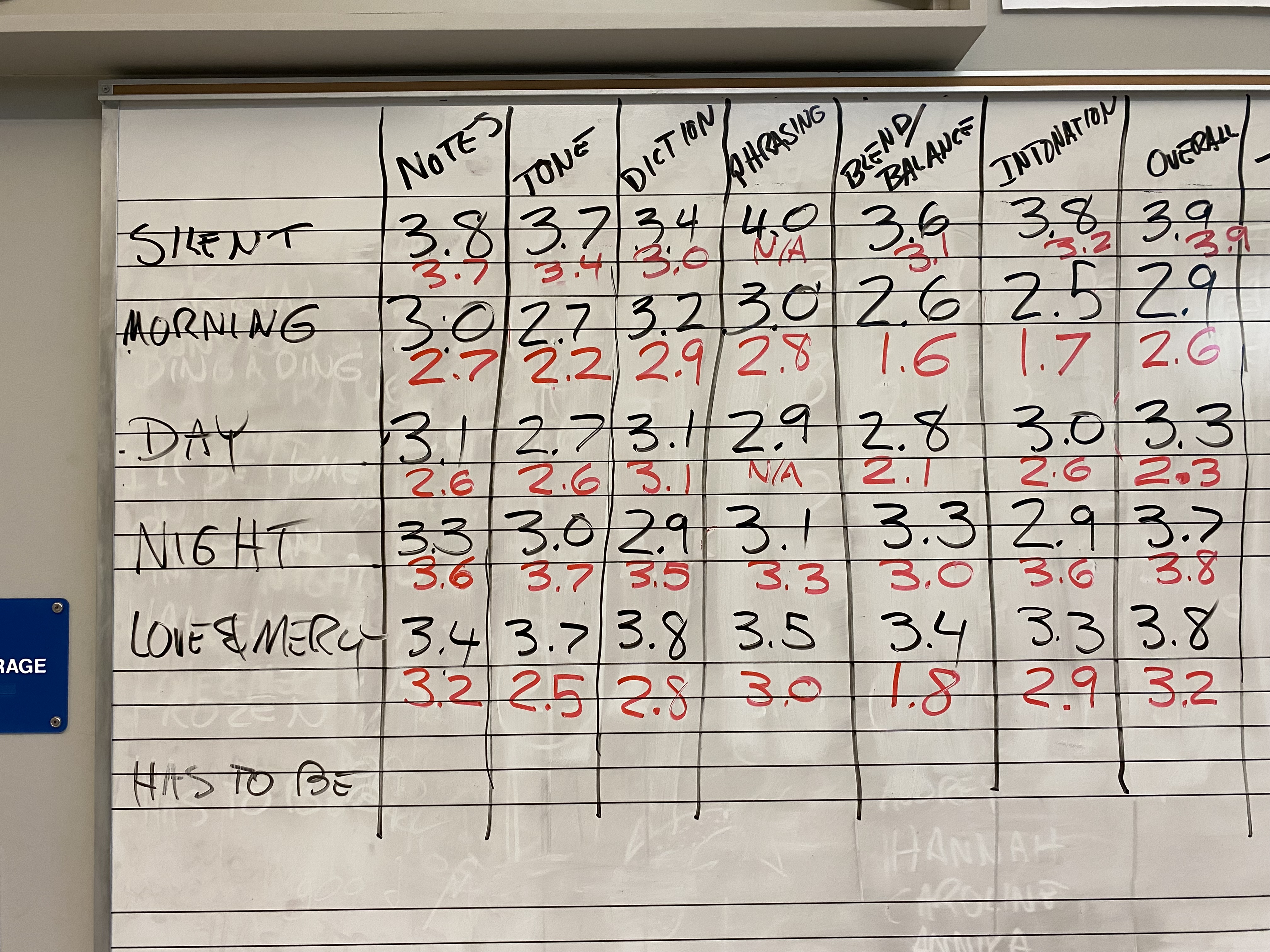
We all found it interesting that the only song that appeared to sound not as musical the second concert (On Christmas Night) was the only song we did not focus on during the revision process. Yet those song scores for concert #2 met our goals (any score between a 2.9 and a 3.1 or so is the target score for every indicator) and were closely aligned to the scores of the other songs. In other words, we were significantly more consistent for concert #2. I was extremely proud of the students in Treble choir after the second concert – not because they did “well”, but because they showed so much musical growth where additional musical growth was most needed. It was a real learning experience for them and reinforced that the class is not a talent-based course, but a skills based course in which they can continue to demonstrate growth over time.
The benefits of going through this process each concert season? Too many to even begin to mention. But the overarching benefit is to get my students to understand the role and responsibility that they have as musicians. My favorite analogy is to reference the Impressionist painter, George Seurat who used “dots” of pure color on his canvas to create his paintings. Below are two pictures of the exact same painting:


We know that our audiences look at the lower picture. But training my singers to look at the same painting from the top picture’s vantage point is one of the great joys of my job. I believe that this is an essential component of training my students to become musicians, not just performers. And when they do understand that it’s the essential pieces that make up the whole, it is my hope that they will never approach either their singing pedagogy or their music the same way ever again. This remains my own annual Big Audacious Goal. The concert revision process each term is a really cool microcosm of developing that.
Posted in Etcetera
Leave a comment
Oct 7 PD: Standards Based Awesomeness for the Arts
For our session today – here are some great resources to reference in moving forward with your work!!!
General Resources worth checking out:
- Argy’s Blog – this is a MUST! Put in your e-mail address to subscribe and get all her updates!
- Student Centered Learning – great, brief article in Edutopia
- Differences Between Teacher-Led vs Learner-Led Education — Practical Steps to Make Change Happen
- 7 Strategies form for Formative Assessment – from Jeff Beaudry, Associate Professor Educational Leadership, University of Southern Maine.
- Metarubric: Criteria for judging the quality of rubrics—a rubric for rubrics
- A Variety Of Perspectives: What is “good” assessment?
- iRubric – a SICK amount of rubrics, sortable by tons of criteria, each of them editable (my “go to” when I’m stuck for ideas).
Visual Art K-12
- List of outstanding Art Education Blogs
- North Carolina “I Can” Statements, for Visual Art, by grade-span! You could design an entire program around these! Use each one to design your own indicators for your applicable courses. Transition from, “This is what I teach” to “This is what my students learn”!
- Grading Art – a compelling document with an immense dive into every component of our classrooms imaginable.
- Kennedy Center Digital Resources – Lesson Plans, searchable by grade level and subject!
Music K-12
- North Carolina “I Can” Statements, for Music, by grade span! I have used these a hundred times to discuss learning targets, standards, indicators and scope and sequence for Music Education. Transition from, “This is what I teach” to “This is what my students learn”!
- Carnegie Hall Digital Resources/Lessons – a great collection, by grade-span.
- Kennedy Center Digital Resources – Lesson Plans, searchable by grade level and subject!

Posted in Etcetera
Leave a comment
video assessments
Nothing philosophical here, just a thread showing how I assess my singers’ video submissions. I just finished my first song submission of the school year (Riu Riu Chiu), assessing 31 Chamber Singers kids over my morning coffee, took less than half an hour and was a joy to do. Here are the basics for me:
- Have a folder of practice tracks. I have traditionally done my own (on garage band transferred over to itunes) which provides me the benefit of my knowing down cold how each voice part goes. Now however it’s a combination of my own recordings and Matthew Curtis recordings, a year subscription for $650 I believe if your budget can support that.

2. Have your Standards and Indicators in place. Ours at York High School are linked here. I think it’s essential never to score an assessment “event”, but rather to assess the skills embedded in that event. This reinforces that the assessment/video is not a hoop to be jumped through to complete, but rather a demonstration of specific learning targets. It also reinforces that the music is not the goal but the delivery vehicle!
3. Decide which indicators you are assessing for your singers’ video assignment, and rubrics ready to roll for them. In my case I’ve created a rubric library, transferable directly to Google Classroom assignments.
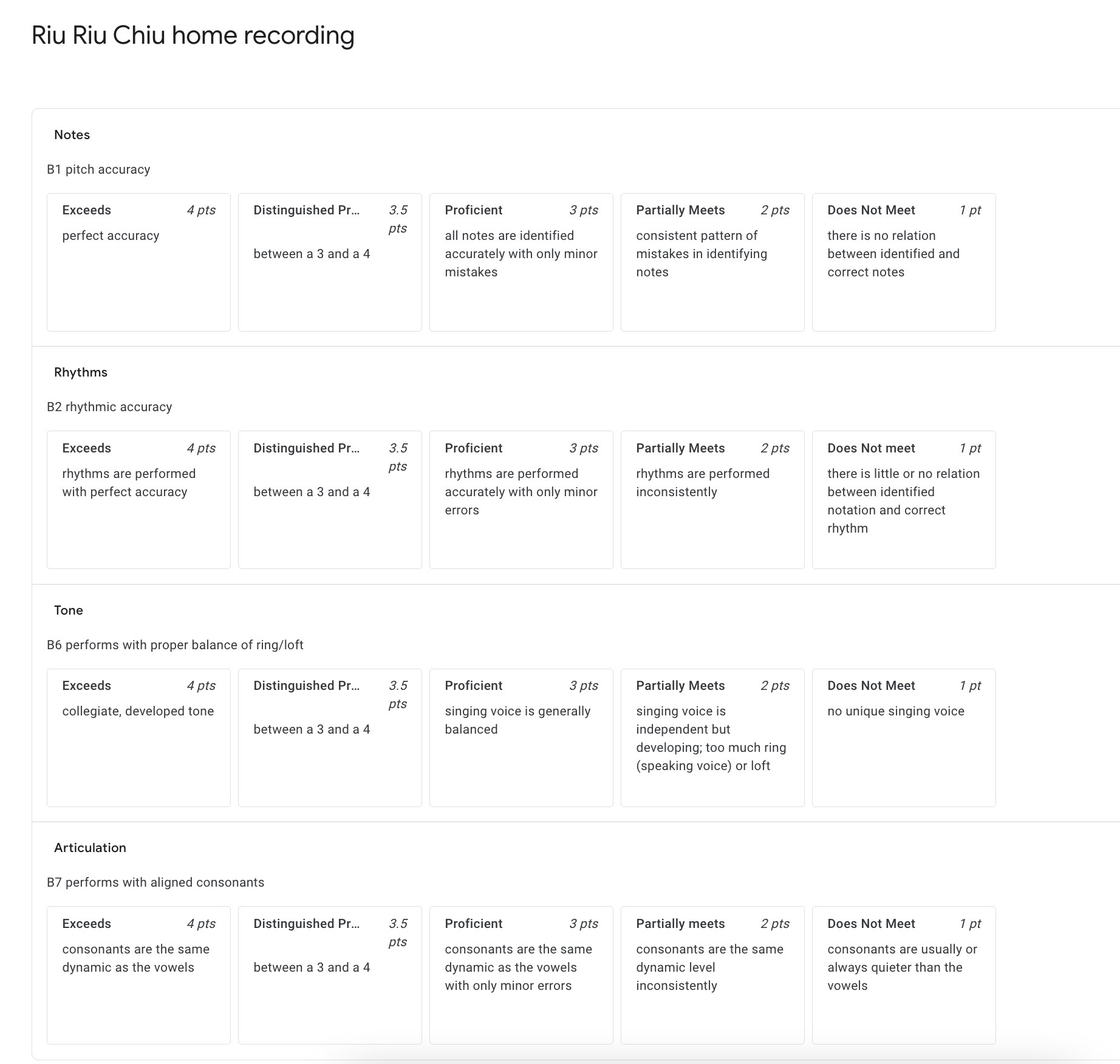
4. Assign the video in google classroom and then score directly IN google classroom. Their videos are assigned usually with a cushion of 4 days to complete them, and they are sung with a practice track in the background (I can assign “practice track of your choice” or a specific one such as the full group equal or their part predominant or missing). You will notice here that I’ve done two things with each video submission. First, I merely click on the indicator score the singer has earned for each target. This gives the raw score for the singer so they can see how they did against the rubric. Second, I use Mote to voice record my feedback to them. This is me giving them feedback on their technique, formative feedback on their tone, elaborating why they may have had a specific indicator score low, or commenting on general points. It’s my personal communication with them that is invaluable.

5. As I score each submission in one browser window on my left, I transfer those same scores for those same indicators to powerschool in a separate browser on my right. In the time it takes to hit “return” on my student’s video in google classroom, that’s how long it takes to add the numbers to powerschool; it takes zero extra time.

A few other quick things:
- You’ll notice a fifth indicator, “D1”, this is my “meets deadlines/personal responsibility” indicator. The promise of standards based reporting 5 or so years ago in Maine was that we could report out grades, and completely separate out habits of work and learning on transcripts(!) which means Colleges could have identified bright students who don’t work particularly hard, as well as students who might struggle academically but are dependable and diligent. But, alas, it was not to be. As a result, I now have to be transparent about that distinction in my grading. Students who are tardy with their submissions (you’ll notice two of them above) can ALWAYS submit their videos later for full credit on their academic indicators… but the “1” for D1 remains.
- You’ll also notice that I display their indicator scores but they have overall percentage and letter grades for the course. My tech folks over at the central office worked with me about 8 years ago to create a system where I punch in a “4” and powerschool spits out “100”. It’s wonderful, and anyone can do it. 4 = 100%/A+, 3.5 = 96%/A, 3 = 88%/B, 2 = 70%/D-, 1 = 60%/F, 0 = 0%/F (failed to submit). The best thing about this is I can still weight each indicator individually if I want to, if their tone for instance is their primary objective for an assessment. But each indicator gets a score which feeds into the overall course grade, just like traditional grade books.
- Manageability is key. Several things I do to ensure it for me is: 1. I always have my assessments due Friday evenings by 9 pm. That way I have my weekends, usually Saturday mornings with my coffee, to score them. I could just as well make them due Wednesday evenings giving me Thursday/Friday at school to score them. 2. I never assess all my classes at the same time. This week I assessed Chamber Singers. Next week I’ll assess my Treble Choir and maybe my chorus as well, though a more rudimentary recording for the latter group. 3. I never assess a portion of music longer than 25 or 30 seconds long. Anyone who has ever judged knows that 90% of what you need to hear you hear is in the first 10 seconds or so. I’m strategic as to which section needs the work on notes and rhythms, but every other indicator can be assessed within a few measures. On average, I’ll assess between 2 and 4 pages of music at any given assignment.
Assessing my students is one of the joys of this profession for me, because I know how much I WASN’T able to do for my kids before technology caught up with our needs. Reach out if you have questions, thoughts or want any resources shared with you! rwesterberg@yorkschools.org
 Goober Music Teachers